




What Is a Linear Actuator? How It Works & Types
Highlights
Linear actuators transform energy to create linear motion.
The electric, hydraulic, pneumatic, and mechanical types work for most jobs.
The most critical specs are stroke, force, speed, and duty cycle.
The electric models are good for precision work. Heavy loads are best for hydraulic models.
The lifetime is dependent on the ingress protection and mounting of the system.
Push a hospital bed up. Ensure a solar panel faces the Sun and raise a factory gate. In each case, something moves in a straight line, and a linear actuator commonly does the moving. The part is easily overlooked. It is sold in machines or under the bed. But if not selected properly, it can lead to jammed lines, motor burns, and warranty issues. This article explains what actuators are, the various types of actuators, and precautions before ordering.
Explaining Linear Actuator
A linear actuator is a machine designed to produce straight-line movement. It carries, pulls, pushes, or tilts a load. Most use a motor, fluid pressure, or compressed air as the power source. The result is a rod or carriage that moves back and forth over a given distance.
Main Parts Inside an Actuator
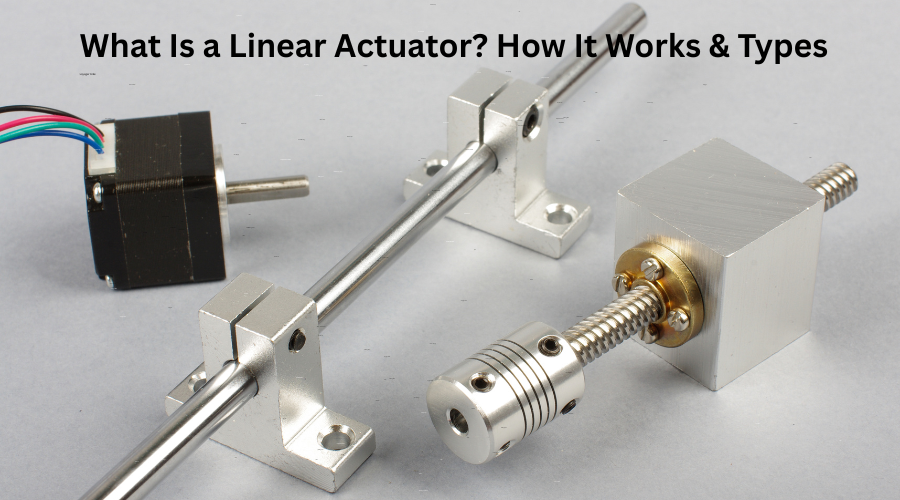
Many of the units have common parts: A power source is required for movement. That power is converted to linear power, usually in the form of a screw, belt, or piston in a transmission. A rod or slider is used to carry the load. A housing protects it from dirt and controls everything. Electric models have a motor, gearbox, and limit switches. Some include a feedback sensor, such as a Hall effect or potentiometer, which reports position. Hydraulic and pneumatic units replace the motor with a cylinder, seals, and ports. Seal quality is of huge importance. You can expect a cheap seal to leak within a month.
How Does a Linear Actuator Convert Motion?
The motor rotates a rotary power mechanism, such as a lead screw or ball screw. A nut on the screw cannot rotate, so it slides along the thread. This sliding action pushes the rod out and in a line.
Electric Linear Actuators
The most common electric units in industry and consumer products. The gearbox is connected to a DC or AC motor that drives a lead or ball screw. Common voltages are 12 V, 24 V and 48 V DC, and 110 V or 230 V AC for the heavier models. The speed varies from about 5 mm/s to more than 100 mm/s for high-force and light units, respectively.
Lead screw designs cost less. They’re self-locking, so they hold position without power. However, they tend to run at a low speed and wear out quickly. The designs of ball screws are more expensive and have a much longer life compared to a lead screw, which has an efficiency of 0.3 to 0.5. The force is very variable: 50 N on the smallest, up to more than 25,000 N on industrial units.
Hydraulic Linear Actuators
Hydraulic actuators use pressurized oil. A piston moves, and a pump pushes fluid into a cylinder. The force output is very large since oil does not compress easily. Usually, the cylinder is used for lifting tens of tons, and the working pressure is about 100 to 350 bar. They are used in excavators, presses, and heavy gates. The trade-off is complexity. A pump and reservoir, hoses, valves, and filters are required. Leaks make a mess and cost money. The performance of oil changes with temperature. Nevertheless, when brute force is needed in a limited area, nothing beats their efficiency.
Pneumatic Linear Actuators
The pneumatic units operate on the basis of compressed air at a pressure of 6 to 8 bar. They are quick, easy, and inexpensive to make. They are widely used in packaging lines, sorting gates, and pick-and-place arms. A few hundred strokes per minute can be achieved with simple valve control. Air compresses, though. This makes precise positioning difficult, and the force is less than hydraulics. The energy used for supplying the air to a standard 50 mm bore cylinder at 6 bar is also noticeable. Pneumatics are a good option if your site requires compressed air. Otherwise, it might not pay to add it.
Mechanical and Manual Actuators
A mechanical actuator is created by hand cranks, gears, or screw jacks to cause movement. The operator rotates a wheel, and a screw hoists the load. NO electricity is required at all. You still find them on valve stems, stage equipment, and remote sites for this reason. The screw jacks make up a larger sub-group. They carry loads from 0.5 t to hundreds of tons, and sometimes are used for automation control by an electric motor. Gear ratios of 5:1 or 20:1 trade speed for force. Slow, steady, strong. Engineers still widely use them for simultaneous lifting of heavy platforms.
Where Linear Actuators Are Used
Industrial Automation is the largest market. Guards, clamps, valves, and conveyor diverters are moved using actuators. Quiet electric versions are used for medical beds, dental chairs, and patient lifts. They are used on tractor seats, spraying booms and feed gates in agriculture. Solar trackers use weather-tight mechanisms that turn panels to move with the direction of the sun during the day. Compact 12 V actuators are found in furniture, like in recliners and sit-stand desks. They are used by marine and truck manufacturers for tailgates and hatches. But they are applied in very different ways, hence the enormous range of variations in spec sheets.
Cost and Sourcing Considerations
Price is a reflection of quality, stroke and force. When buying wholesale, the price of 12V electric actuators for furniture lines ranges from $15 to $60. Industrial electric units, $150. Hydraulic cylinders cost anywhere from $100 to a few thousand dollars, depending on bore and pressure specifications. Typical pneumatic cylinders generally sell for between $20 and $200. Minimum order quantities vary. Minimum is 10.
The minimum quantity of stock is 10. Normal changes in stroke, voltage, or housing require 100-500. Contact providers to see their pricing and lead times. Standard parts delivery takes 2-4 weeks. The time for custom builds is 6-10 days. Always ask for a sample and test before making a large purchase.
Maintenance and Common Failure Points
Most failures can be related to a few reasons. Overload Loads the Motor. Side loading bends the rod. Worn seals expel moisture, which destroys electronics. A lead screw has dust that grinds over the threads. Most of this will be avoided if a little attention is paid early. Lubricate screws as recommended by the maker, which is typically every 6 to 12 months. Inspect rod seals to see if they are weeping. Inspect cables and connectors. Replace filters and do an oil cleanliness test in hydraulics. Keep a log. If you can see a unit's hours and loads over time, you will know before it fails which one is the weak unit.
Conclusion
The concept of a linear actuator is simple, but it varies widely. There are electric, hydraulic, pneumatic, and mechanical types, all suitable for different tasks. Match the type and protection rating to the site based on load, stroke, speed, and duty cycle. Test a sample under simulated conditions. This is a very minor step that pays off in a great deal of trouble-saving.
FAQs
Who is the bulk linear actuator supplier for equipment manufacturers?
There are a number of factories that are certified to ISO 9001, which offer bulk orders that generally range from 50 to 500 units for each model.
What is the wholesale price of linear actuators?
The wholesale price of small electric units is generally about $15, while industrial models sell for $1,500 and above.
Which supplier can provide custom linear actuators that accept custom stroke and voltage?
Many manufacturers produce to spec, modifying stroke, voltage, feedback, controls, housing, etc., typically starting at 100 units.
Who offers bulk linear actuators with customization at discounted rates?
Some suppliers offer a 5- 15% reduction for custom orders of 500 units or more, particularly for repeat orders.
What is the production time for a custom linear actuator?
Standard models are ordered and received in 2-4 weeks. Typically, custom builds require about 6 to 10 weeks.
Leave Your Comments
Recent Post



Get in Touch With Us
Have questions or need more information about our products and services? Fill out the contact form and our team will get back to you as soon as possible.
